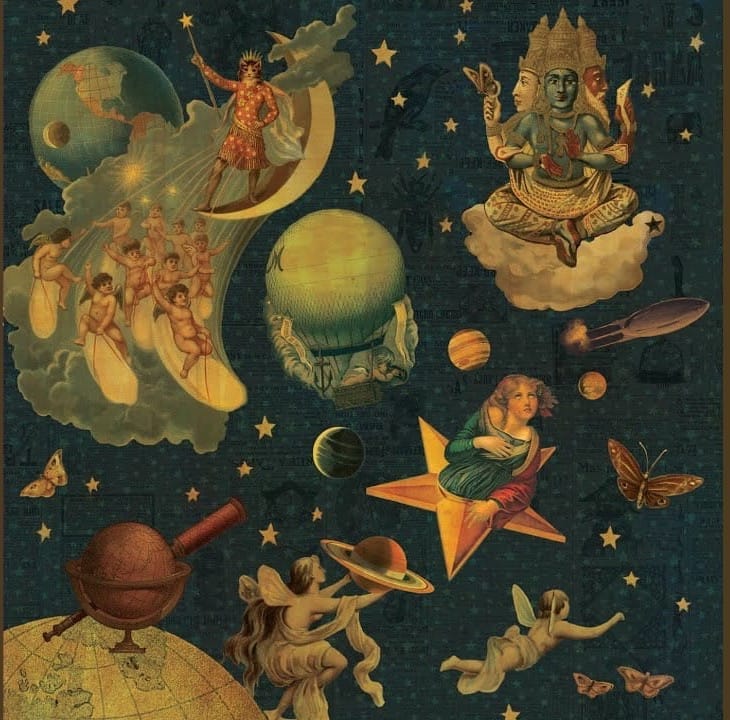
MELON COLLIE AND THE INFINITE LIBERAL SADNESS

CW: More death chat throughout.
N.B. For my short critique on the problems of liberalism and liberal psychology you can look back at a previous post that can be found here.
N.B. This isn’t really a blog post on what liberalism is per se, more on the psychological responses that the death of liberalism is evoking. If you want a good summary of the history of liberalism and what it is look no further than this podcast right here.
THE YEAR IN DEATH
2025 was a year of bereavement for me and my family. Two shocking deaths, two loved ones taken before their time in complex, painful and unexpected situations over which we had no control. 8th of March 2026 will mark the first anniversary of my father’s death. The other death is not my story to tell, so I won’t tell it.
When my dad used to visit Leeds with my mother, to see me and my partner, we would go out to do something cultural (visit a museum, see an art gallery). Approximately 10 minutes into a visit of this kind my father would look at me and say, ‘fancy a pint?’ and off we would go to sit and drink and chat whilst our better halves enriched themselves in a healthier and more culturally engaged manner, joining us when they were done.
My dad, someone who carried trauma and had the dealing mechanisms to boot, sometimes struggled with relationality. However, in those moments I felt very close to him. Something I only really comprehended when their future realisation came under threat due to his imminent death.
I remember, in the month where he became ill and died, I tried to negotiate with a God I’m not convinced exists. Fate remained unconcerned with my negotiation attempts and my bargaining was routinely driven down as the month went on.
’10 more trips to the pub, surely we’ll have 10 left…5 more, 4 more…c’mon Big Man...give me 1 more pint with me Dad before he goes.’
There were no more pub trips. I will live the rest of my life knowing there will never be any more trips to the pub with my father ever again.
I would like to suggest that 2025 was also the year liberalism finally died in the UK. Sure, it never really recovered after the 2008 financial crisis when the rot set in. But it managed to hobble on, degraded and corrupt, for almost 20 more years before it gave up the ghost, sat down and died.
2024 was its last gasp. Marxists knew it was already fucked; we kept trying to tell others. But everyone was swept up in this bizarre notion that Sir Keir Rodney Starmer’s venal and authoritarian Labour Party were somehow going to save liberalism and take us back to its glory years. Despite the fact that none of the material conditions that sustained Blairism (a booming economy that hadn’t withstood 15 years of austerity, a stable American empire, a globe to incorporate into capitalist social relations etc) were present anymore, the vibes were staunchly Blairite. Things could only get better and baby, you better believe we were going to party like it was 1997 all over again!
Working in the trade union movement was incredibly frustrating and tedious at the time. Looking around at everyone’s excited and hopeful faces, I couldn’t see what they were seeing. I couldn’t understand why they thought this man who had played a key part in destroying the last viable hope of social democracy in the UK (the Corbyn movement) wasn’t just going to continue taking Labour on its rightward trajectory, greasing the wheels for future fascism.
But then, as Starmer arrived in power and set about doing all the horrible shit anyone who was paying attention always knew he was going to do, the lights came up and the music stopped and all the faces of hope and excitement became ones of bitter, bitter disappointment. And that was that. My Dad was dead. And somewhere in the hearts of liberals everywhere, consciously or not, they knew liberalism was dead too. This is how I’ll remember 2025.
DOTH MY EYES DECEIVE ME?!
Let’s recap. In 2026, our so called ‘liberal state’ is the 5th largest economy in the world. It’s also one of the most unequal societies with some stupendously rich people, 1 in 4 kids in poverty, and a middle-class that is becoming rapidly downwardly mobile. Everything is fucking expensive (partly due to the climate crisis, partly due to massive amounts of profiteering). Nothing works anymore. Any money that the government pumps out is hoovered up by private firms making a profit before it gets to be used for any form of societal good. Both major political parties have virtually identical policy platforms and their rightwards drift is paving the way for a fascist Reform government in 2029.
It’s been like this for a while.
You’d think liberals would find it harder to crow on about ‘freedom’ and ‘British Values’ and ‘hope’ and ‘democracy’ and so on. And yet their crowing grows louder. When presented with the facts of the matter they look through you, they insult you, they shut you out of their institutions.
Psychologically, what is going on here?
THE 7 STAGES OF GRIEF (DENIAL, DENIAL, DENIAL, DENIAL, DENIAL, DENIAL & DENIAL)
For months after my dad died I would regularly and repeatedly say to my partner ‘I can’t believe he’s dead’. This wasn’t a figurative turn of phrase; it was very much literal. I simply couldn’t get my head around it. My son still can’t. He asks if we can put grandad’s bones back together so grandad can come back to life and play with him again. He tries making magic potions that might resuscitate ‘sweet, lovely Grandad’. It’s no surprise he can’t deal with the finality of it all being so suddenly over. I’m a ‘grown up’ and I find the whole thing ineffable. Beyond language, I sense its unknowability at my core.
I can’t help but draw parallels to how liberals have dealt with the death of liberalism. I see denial everywhere. From those who think rejoining the EU will solve everything to those who think Starmer ‘needs more time’, to those that are waiting for Trump to leave the White House, or for Ukraine to prevail against Russia.
In their grief-madness, liberals are deluding themselves to the point that they are encouraging people to sit quietly whilst everything collapses. Many of the most materially comfortable amongst us advocate that we ride it all out (maybe they can but 1 in 4 children living in poverty certainly can’t!). They say that everything will go back to normal and be just fine. That our leaders will save us, rather than push us further into chaos and destruction.
Just like I can’t believe my dad is gone forever, they can’t quite believe liberalism is dead and gone forever…even though they know it is. They are stuck within a condition that Sigmund Freud would describe as ‘melancholia’.
MOURNING AND MELANCHOLIA
This isn’t technically the first-time liberalism has died. The last time it was thrown into utter crisis was during the two World Wars of the 20th century. How could an ideology based on ‘freedom’ lead to such mass death? Indeed, after 1945 liberalism was displaced by social democracy for decades, only really rearing its head once more at the end of the 70s when Thatcher and Regan came into power and embarked on the neoliberal project whose inert corpse we currently see lying before us.
Freud wrote Mourning and Melancholia in 1917 towards the end of the first of these World Wars. It is an essay that tries to delineate between a grief one can process and move through (mourning) and a grief in which one is stuck (melancholia).
Whilst this essay can most obviously be applied to the psychoanalytic therapeutic relationship, Freud also recognises that mourning or melancholia can result due to the loss of “one’s country, liberty, an ideal, and so on.” Maybe it was in part written as a response to his own grief in relation to the death of liberal ideals in his own time.
To Freud, mourning is a normal and healthy response to grief. We are conscious that we have lost a love-object. We know we are grieving and we know why. Our grief process is just that, a period where we process and come to terms with the fact that something important to us is gone and gone for good.
Melancholia (maybe we would call this depression in modern parlance?) occurs when “one cannot see clearly what has been lost” it is unconscious and results in a condition whereby “the object itself is abandoned, then hate is expended upon” a “new substitute-object.” This ‘shadow object’ is internalised into the ego, and the subject ends up “railing at it, depreciating it, making it suffer and deriving sadistic gratification from its suffering.”
The individual becomes stuck in this melancholia, no longer mourning the loss of the actual love-object, but instead incorporating its shadow into their own ego, keeping the shadow alive indefinitely through repetitive behaviours such as self-criticism and reproach, and projecting the shadow onto others leading to hostility and aggression in relationships. The job of the psychoanalyst is to bring this melancholia into consciousness so it can become mourning, and be consciously processed.
Typically, the Mourning and Melancholia essay has been used by leftists to understand how communists and socialists struggled to come to terms with the fall of the Soviet Union and the triumph(?) of liberalism. The 90s and early 2000s were a low point for Western leftism, where those previously engaged in struggle turned inwards towards self-reproach and inaction. Reflecting this, in the UK during these years, Blairite neoliberalism was so powerful that the left as a political project was regularly referred to as ‘entombed’ (wooooooooooohhh wooooooohhhhh - ghost noises, deathly imagery!)
Liberalism left unchecked to do its thing for the best part of 50 years, however, means that nowadays things have gotten so obviously materially shit that the left has made a huge resurgence (in the UK, think Corbyn, Polanski, Your Party, Palestine Solidarity, Extinction Rebellion, Just Stop Oil etc etc). Leftist ideas are becoming popular, and people are looking for a real alternative to the liberal way of doing things.
For what it’s worth, from my own perspective, I’ve been mostly saying the same stuff now for 20 years, but it’s been interesting to see those same messages become more resonant with colleagues, trainees etc. in more recent years. The ravages liberalism has wrought have ultimately brought the inherent problems of liberalism clearly into view. And due to this, progressive ways of thinking are being taken far more seriously.
Vitally, the left is no longer stuck in its melancholy, looking back to a time when the Soviet Union still existed. Instead, it is looking forward in various ways, whether they are to a society based on a green industrial revolution, de-growth, or any other number of future-focused concepts. Socialists are now looking to the future and thinking about winning elections, collective action, and a renewed union movement. Finally, after almost 30 years the left has broken through its melancholia into a mourning and an acceptance that what we once had is lost. Only once we accept that what is lost is gone are we able to so process the grief, move on and rebuild.
The current conjuncture is better defined as a time of liberal melancholia, something I will spend the rest of this blog post exploring within our professional context.
LIBERAL MELANCHOLIA AND PSYCHOLOGY
Whilst I’m far from the first person to notice this, what I find fascinating about liberal melancholia as a particular psychological formation is that it’s very light on self-loathing and self-reproach and very heavy on projecting anger outwards to those who might suggest their project has failed.
In short, as far as I can see liberal melancholia mostly takes two forms, inward disavowal and outward projected aggression.
Inward Disavowal
Time and time again I see people within my profession refer to it as ‘noble’ (no it’s not – have you read anything on the history of psychology?) or talk about psychologists as ‘social justice warriors’, ‘hope-catchers’ or whatever else (again, seriously…go read a history book).
I see liberal melancholia in my own profession when EPs try to argue that we should be hopeful with regards to the contents of the upcoming White Paper on SEND and try to support its implementation as best we can. When liberals cling onto practices that don’t work anymore (e.g. consultation, co-construction). I see slides, from talks at a conference about inequality and psychology that cost hundreds to attend, arguing that the most ‘punk rock’ thing an EP can do in 2026 is ‘sit on the fence’ (Listen to Crass, I suspect they’d disagree).
Liberal melancholia incorporates leftist historical figures into liberal mythology and defangs them. The suffragettes are understood as the original liberal feminists, despite the fact that, had they enacted their violent programme today, liberals would have condemned their actions. Same with Nelson Mandela, or Malcolm X. Important thinkers incompatible with liberalism are marginalised (e.g. Marx, Fanon etc) whilst others are softened and shorn of their radical credentials (e.g. Vygotsky). Liberals also love to dehistoricise. A recent example I have seen is where a colleague was justifying their own inaction by extolling the virtues of Camus’ accommodationist attitude towards Algerian liberation, as if he wasn’t widely condemned for doing so at the time.
Outward Projected Aggression
Liberals project their melancholia outwards when they tell leftists to not ‘think in binaries and take sides’, ‘see things in a nuanced and sophisticated way’ and to ‘work with’ as if you can work with authoritarians and fascists, as if there are nuanced positions to be taken on genocide.
They claim, unsubtly, that the progressive views of the leftist are no different to the rancid views of the fascist, via the debunked concept of horseshoe theory. Their disavowal is so strong that, whilst the worldview they love collapses around them, they put their fingers in their ears, pretend everything is fine, stick to their guns and accuse those on the left of being unable to accept criticism (as if self-flagellation isn’t core to leftist practice in the first place!)
At present, the most dangerous thing any leftist can do is pierce liberal melancholia by critiquing the social injustices liberalism has created or, even worse, trying to challenge its embedded power dynamics. This results in both the disavowal and the aggression mechanism being deployed simultaneously. Regardless of how politely the critique was made, the leftist critic instantly becomes an unreasonable bully in the eyes of the melancholic liberal. Yet at the same time the liberal directs bullying-behaviours towards the leftist by throwing accusations with no basis in material reality, that only make sense at the affective level of their melancholic discontents.
Stand up for Palestine, get called an antisemite. Stand up for trans-rights, get called a misogynist. Stand up for economic redistribution and you get called a loony lefty, a purveyor of 6th form politics or just plain old naïve. Of course, if the leftist continues to push for change, they simply get arrested under the guise of…you guessed it...protecting ‘liberal freedoms’.
Previously, I have tried politeness and I still got yelled at so I’m just going to state the facts plainly. The liberal defence of liberalism is all clearly bullshit. It’s obvious to anyone who is paying attention that now is exactly the most important time to take a stand. To take a staunch position. To do what is right, not what is deemed pragmatic by those accelerating the rocket into the sun.
TOWARDS AN AFFECTIVE MARXIST POLITICS AGAINST LIBERAL MELANCHOLIA
“As always where the libido is concerned, man has here again shown himself incapable of giving up a satisfaction he had once enjoyed.” – Sigmund Freud, On Narcissism, 1914
‘Well…You can prove anything with facts, can’t you’ – Stewart Lee, Stand Up Comedian, 2005
If I could bestow one piece of advice to anyone interested in critiquing the liberal approach it would be to stop engaging with liberals on a semantic level (i.e. taking the words they are using at face value) and instead try to assess what psychological and material effects these words have in our social/political/economic sphere.
Liberal disavowal, whereby the liberal denies the horrors that liberalism has caused and instead cries freedom, serves the important function of preserving the self-concept (or ego) of the liberal subject, deep in their melancholic reverie. They unconsciously know that the world they loved is gone but they have internalised it as disavowal and projected it as aggression.
This is not a battle that can be won in the marketplace of ideas. You cannot use facts and figures to win people around (trust me, I’ve tried). This is a battle fought on a psychological terrain. It is about affect. The liberal isn’t interested in the truth; they are interested in preserving their sense of self. Their melancholia is a defence mechanism that protects this feeling. Because if liberalism is dead, they were dead wrong. If liberalism is dead, then they must give up liberalism. If liberalism is dead, those commies and socialists they’ve been projecting aggression onto all these years might have been right. And so, just like the grieving son who cannot believe their father is dead, the liberal remains stuck within a melancholic loop, like the locked groove at the end of a record repeating the last second of music over and over and over again.
CONCLUSION
Liberalism died before and came back. Now liberalism is once more dead, the melancholic question to ask would be, can it be revived? Can it’s grey, mottled and skeletal hand shoot out from the fresh earth atop its grave? Can its bones be reassembled? Can it get back up and lurch on zombie-like for another generation or so? As Gramsci said, ‘the old is dying, and the new world struggles to be born,’ pointing out that after all ‘now is the time of monsters.’
My view is that liberalism has shuffled on long enough and the prerequisites that sustain it are simply no longer there. Primarily, the climate crisis precludes the continuation of liberalism. The limited freedoms granted to those in the West, were only possible via extraction from colonial externalities that have now been brought into the crisis ridden system that used to benefit from them.
There are no more seas to plunder (why else would the tech-bros be exploring the possibility of space travel?) Our ravaged earth is showing clear signs of sickness there are no more cheap resources to be harvested. Capital can’t afford to be kind, it can’t afford to be liberal, and I don’t really see any mechanism by which we could turn the clock back on this. We can only go forward either towards fascism, or some form of socialism. In a drive for efficiency, liberalism sold off the fence whilst you were sitting on it, time to stand up.
Ending on a thought in relation to UK domestic politics, liberal melancholia is why I can’t think of anything worse than an Andy Burnham Labour leadership. The last thing melancholic liberals need is more false hope…and in the pits of their melancholic desperation they *will* find it in Andy Burnham. And what will Burnham do when he gets to the levers of power? Pretty much the same as what Starmer has done only with a New Order style Mancunian jacket on. Just look at his voting record, look at his history as a politician. His newly found northern vibes aren’t going to save you.
No, better the UK Labour Party show us what it really is with a Streeting/Mahmood Premiership. Better that our enemy is in plain view, so we can see it clearly and start to organise against it. Better that the UK Labour Party implodes entirely to wake liberals out of their reverie. Only when it has been destroyed, will something better take its place. A rupture such as this may help to shake liberals out of their melancholia towards a more productive form of mourning.
Any Marxist project needs to support liberals to move from their melancholia into mourning so that they emerge from their grief and see the world for what it is. At times this will require engagement and support, at others it will require robust challenge. Sometimes it will require practical alternatives (e.g. the development of progressive organisations, practices and political groups) sometimes it will require the deployment of shame and the raising of a mirror to encourage self-reflection on the gap between liberal values and liberal actions.
The world as we knew it is dead and gone and yes, liberals can mourn that loss, but none of us can get lost in melancholia because we need to start fighting for a real alternative against fascism. We have a world to win.